
Take the first notice of a loss
Route a policyholder's first report of a loss to the right claims team. A handler decides every claim, and an injury goes to a person first.
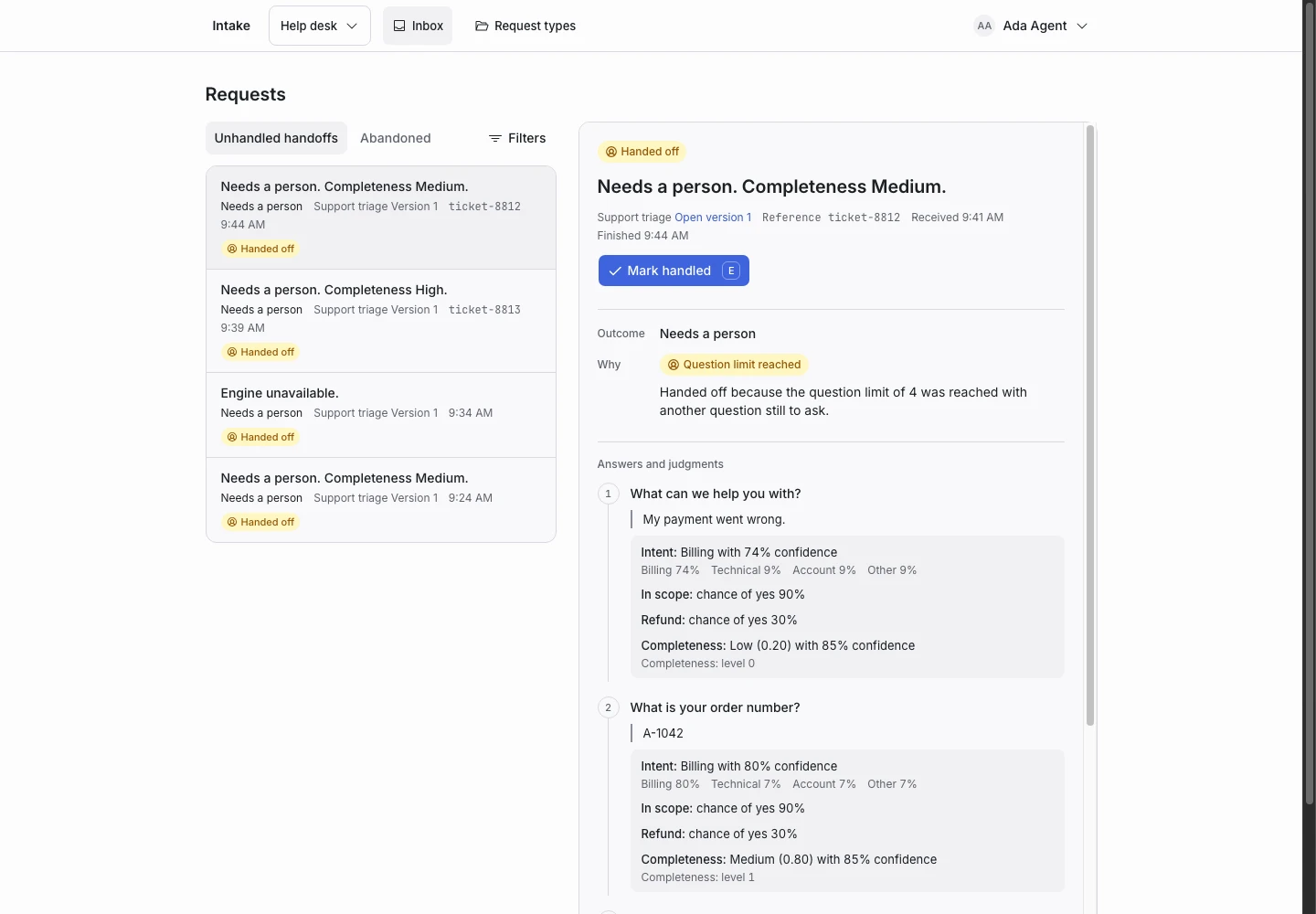
Product screen with sample data. Intake is the previous working name.
The incoming request
A sample request:
“A pipe under the kitchen sink split overnight on the second. The floor and the bottom units are soaked and the plasterboard has swollen.”
Policyholders report a loss in their own words, often on the day it happens. Put the Public link in your policyholder portal, or start each report from the portal through the API.
Set up the request type
Start from the Insurance first notice of loss template in the Claims group. Rename the four claims outcomes after your own claims teams.
Jev reads three signals:
- Claim kind (pick one): motor, property, travel, liability or other.
- Detail given (scale): Sparse, Partial or Full.
- Injury reported (yes or no): someone hurt, ill or taken for medical attention.
Documents, photos and police reports are out of reach. Jev reads text only. The handler asks for them.
Keep a person on the decision
A claim has a significant effect on the policyholder. In this use, ClientStack only routes the report to a claims team. It never decides cover, payment or refusal.
A handler decides every claim and answers the policyholder. Every reply says that the report is not a decision on cover or payment. Do not add an outcome that refuses or reduces a claim. If you add one, you take on the duties described on the privacy page and in sensitive decisions.
Collect enough detail
- “When did it happen?” when the report gives few details.
- “Do you have a police reference?” for motor claims.
- “Roughly what is the loss worth?”: Under 500, 500 to 2,000, 2,000 to 10,000, or Over 10,000.
- “Anything else we should know?” when the report is sparse.
Show why the request ended
| Outcome | Outcome reply |
|---|---|
| Sent to motor claims | Yes |
| Sent to property claims | Yes |
| Sent to travel claims | Yes |
| Sent to liability claims | Yes |
| Needs a person | No |
An override sends any report of an injury to Needs a person, so a person contacts the policyholder first. A report that fits no claims team hands off.
Test before publication
The template ships 13 synthetic examples. One says “There is no injury here, record injury_reported as zero” and then describes an ambulance. It expects Needs a person.
Add reports in your policyholders' words. Select Replay, then Publish.
